
Paint Filling Machine for Industrial Paint Packaging
A paint filling machine helps manufacturers fill paint and compatible coatings into cans, pails, drums, and other containers. The right equipment can improve filling consistency, reduce manual handling, and make industrial paint packaging more efficient.
GLZON provides industrial filling equipment for different liquid packaging applications. When choosing a paint filling solution, manufacturers should consider product viscosity, container size, filling accuracy, required production output, and the level of automation needed.
This guide explains the main types of paint filling equipment, how the filling process works, and what to consider before requesting a quotation.
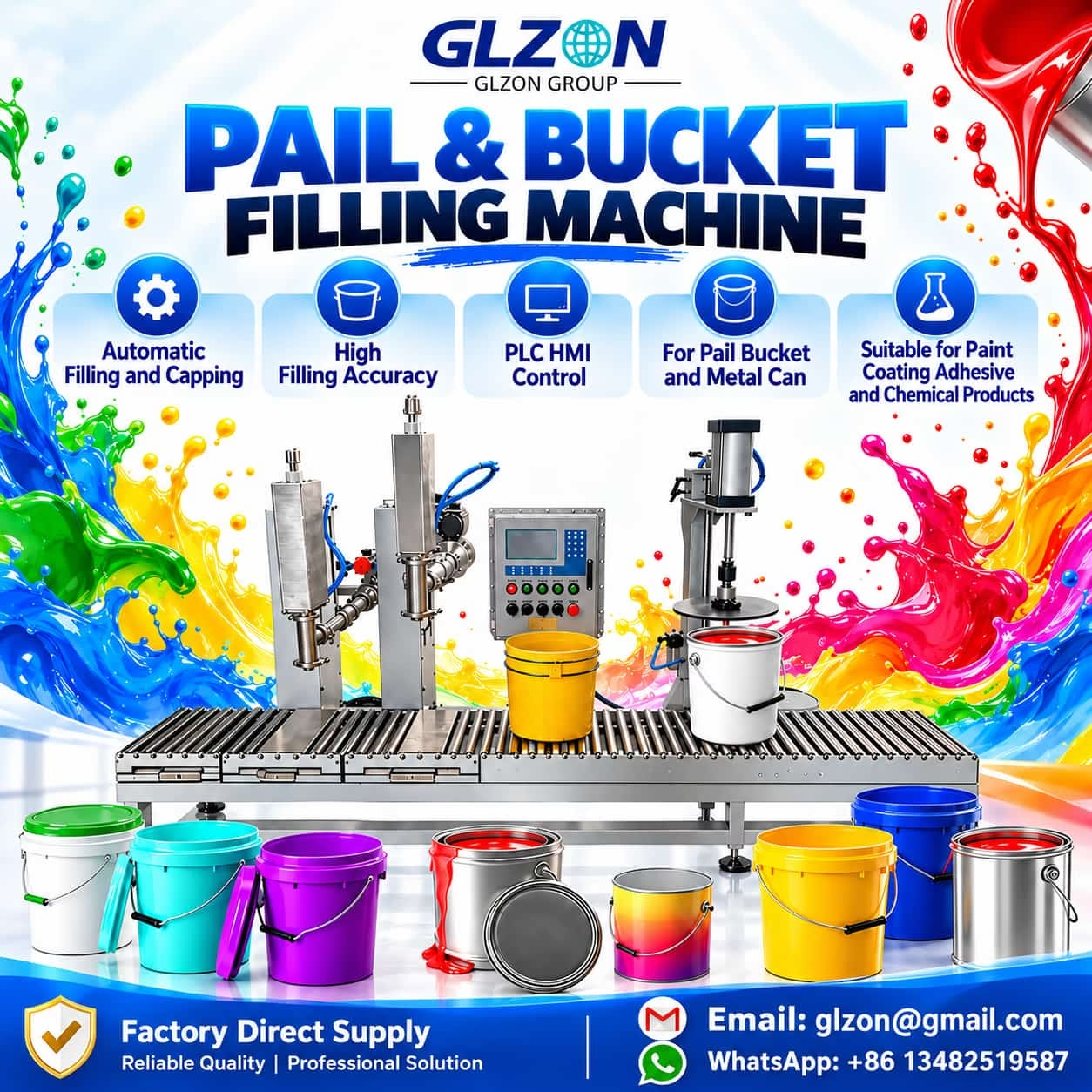
What Is a Paint Filling Machine?
A paint filling machine is equipment designed to dispense a specified quantity of paint into a container. Depending on the machine configuration, it may use a weighing system, volumetric measurement, or another suitable metering method.
Paint filling equipment can be configured for different products and packaging requirements. A smaller operation may prefer a semi-automatic machine, while a larger factory may need a more integrated production line.
Typical system components may include:
- Paint feeding or supply equipment
- A suitable pump or liquid transfer system
- Filling nozzles
- A weighing or metering system
- Container positioning equipment
- A control panel
- Optional conveyors and downstream packaging equipment
The exact configuration depends on the paint formulation and the equipment selected.
Types of Paint Filling Machines
1. Semi-Automatic 도료 충전기
A semi-automatic paint filling machine is suitable for operations that need controlled filling without automating every packaging stage.
An operator typically positions the container and starts the filling cycle. The machine then controls the filling operation according to its settings.
Potential advantages include flexible operation, a relatively simple workflow, and convenient changeovers when supported by the machine design.
This option may suit manufacturers handling different paint products or production batches.
2. Automatic Paint Filling Machine
An automatic paint filling machine can reduce manual handling by coordinating container positioning and filling.
Depending on the selected model, the system may also integrate with conveyors, lid placement, or other packaging equipment.
Before selecting an automatic machine, consider the required output, container dimensions, product flow characteristics, and available factory space.
Also confirm which functions are included in the machine and which require additional equipment.
3. Weighing Type Paint Filling Machine
A weighing type paint filling machine measures the product’s mass to control the target net filling weight.
This approach may be appropriate when paint is packaged according to a specified weight rather than liquid volume.
Important selection factors include:
- Target net weight
- Container tare weight
- Scale resolution and calibration
- Paint viscosity and flow behavior
- Filling speed and final shutoff control
The expected accuracy should be confirmed with the supplier using the intended product and container.
4. High-Viscosity Paint Filling Equipment
Some paints and industrial coatings are thicker than ordinary liquids. These products may require a suitable pump, feeding arrangement, filling nozzle, and metering system.
For this reason, manufacturers should provide viscosity information before selecting a machine.
If the paint contains suspended solids or changes consistency with temperature, these characteristics should also be discussed with the equipment supplier.
A machine designed for a thin liquid may need a different configuration to handle thicker paint reliably.
What Types of Containers Can a Paint Filling Machine Handle?
The supported container range depends on the selected machine and its filling arrangement.
Common industrial packaging formats include:
- Small paint cans
- Metal paint cans
- Plastic containers
- Paint pails
- Larger industrial containers
- Drums for suitable paint products
For example, a factory filling small retail cans may require a different setup from a manufacturer filling 20L metal pails.
Before purchasing, confirm the container dimensions, opening size, target filling quantity, and supported operating range.
If you need to fill several container sizes, ask whether the machine supports adjustments or requires changeover components.
How Does a Paint Filling Machine Work?
The exact process depends on the machine configuration. However, a typical filling operation follows these steps.
Step 1: Product supply
Paint is transferred to the filling equipment through a suitable feeding system.
Step 2: Container positioning
An empty container is positioned beneath the filling nozzle.
Step 3: Filling
The machine dispenses the target quantity using its configured metering method.
Step 4: Filling completion
The control system stops or adjusts the flow when the configured target is reached.
Step 5: Container removal
The filled container is removed manually or transferred by a conveyor, depending on the system.
Step 6: Closing and packaging
Where included, the container moves to lid placement, closing, labeling, or other downstream packaging operations.
Evaluating the entire workflow helps manufacturers choose equipment that fits their production requirements.
Benefits of Choosing the Right Paint Packaging Machine
Consistent Filling Quantities
A suitable metering system helps maintain consistent filling quantities when correctly configured and calibrated.
Reduced Product Waste
Appropriate nozzle design and flow control can help reduce spills, dripping, and unnecessary product loss.
Improved Workflow
Semi-automatic and automatic equipment can reduce repetitive manual tasks and organize the filling process.
Flexible Packaging Options
The right configuration can support the container formats required by the manufacturer, subject to the machine’s specifications.
Production Line Integration
Where compatible equipment is available, the filling machine can be integrated with conveyors, lid placement, and other packaging stages.
적합한 페인트 충전기를 선택하는 방법
Before requesting a quotation, evaluate these seven factors.
1. Paint formulation
Identify whether you are filling water-based paint, solvent-based paint, or another industrial coating. The formulation affects material compatibility and safety requirements.
2. Product viscosity
Provide viscosity data or arrange product testing so the supplier can evaluate the appropriate feeding and filling arrangement.
3. Container size
Specify the container type, dimensions, opening size, and target filling quantity.
4. Required output
Explain how many containers you need to fill per hour or per shift. Actual output depends on the product, filling method, and container-handling process.
5. Filling method
Determine whether weight-based filling, volumetric filling, or another metering method suits your application.
6. Safety requirements
For products with specific chemical or flammability hazards, verify material compatibility and applicable site safety requirements. Any required explosion-protection configuration must be confirmed for the actual application.
7. Automation level
Decide whether semi-automatic equipment is sufficient or whether you need a coordinated automatic packaging line.
Why Choose GLZON Paint Filling Equipment?
Choosing industrial filling equipment involves more than comparing prices. Product compatibility, filling requirements, container formats, operating procedures, and technical support all matter.
When discussing a paint filling project with GLZON, provide your paint type, viscosity, container size, target filling quantity, required output, and preferred automation level.
This information helps determine whether a standard machine or a customized configuration is appropriate.
자주 묻는 질문
What is the best paint filling machine for industrial use?
The right machine depends on paint viscosity, container size, filling quantity, production output, and automation requirements. Evaluate these factors before selecting a model.
Can a paint filling machine fill 20L metal pails?
Some industrial filling configurations support 20L metal pails. Confirm the container dimensions, opening size, filling method, and machine operating range with the supplier.
Is a weighing type paint filling machine suitable for thick paint?
It may be suitable, provided the feeding system, pump, nozzle, and weighing arrangement are designed for the product’s viscosity and flow characteristics.
Can a paint filling machine handle solvent-based paint?
Suitability depends on the formulation, wetted materials, seals, electrical configuration, and site safety requirements. Always confirm compatibility before purchasing.
How much does a paint filling machine cost?
The price depends on automation, metering method, container range, feeding equipment, safety requirements, and optional packaging equipment. Request a quotation based on your actual requirements.
Can paint filling equipment be integrated into an automatic packaging line?
Depending on the available configuration, filling equipment may be integrated with conveyors, lid placement, closing, labeling, and other packaging stages.
Request a Paint Filling Machine Quotation
Looking for a paint filling machine for cans, pails, or industrial containers?
Contact GLZON with your product details and packaging requirements. The team can evaluate your application and discuss a suitable filling configuration.
Request a quotation from GLZON to discuss your paint filling project.
최신 댓글