
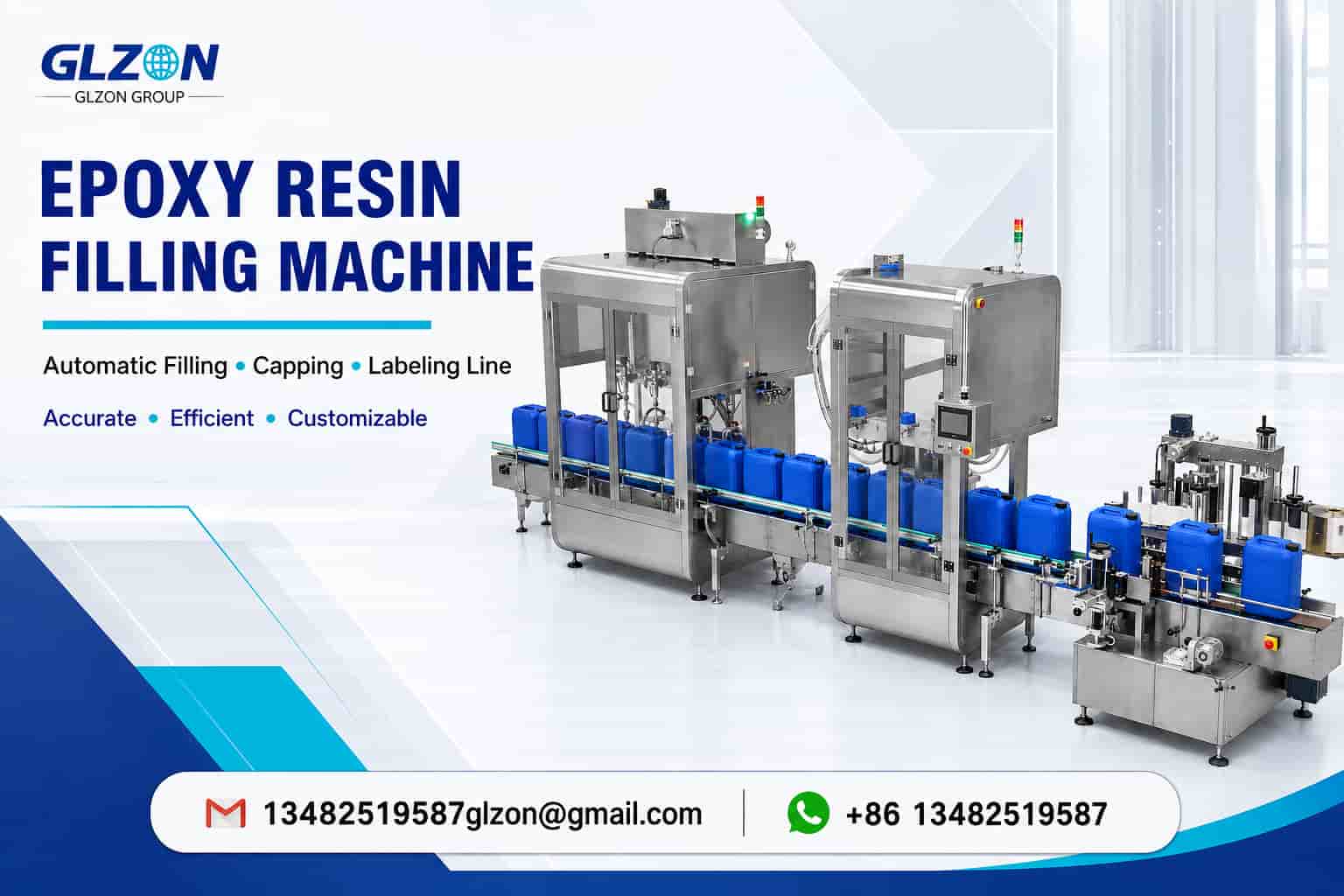
Epoxy Resin Filling Machine for Industrial Adhesives
An epoxy resin filling machine provides accurate, controlled filling for epoxy resins, hardeners, industrial adhesives and other viscous chemical products.
Because epoxy formulations can vary significantly in viscosity, density, flow behavior and chemical composition, manufacturers should select filling equipment based on the actual product—not only the required container size.
GLZON designs industrial resin and adhesive filling solutions for bottles, cans, pails, jerry cans, drums and IBC totes. Semi-automatic and fully automatic configurations can be customized according to the material, production capacity and factory environment.
What Is an Epoxy Resin Filling Machine?
An epoxy resin filling machine is designed to measure and dispense a predetermined quantity of resin or adhesive into a container.
Depending on the product and production requirements, the machine can use net-weight, volumetric, piston, pump-fed or pressure-assisted filling technology.
A complete system may include:
- Product supply tank or feeding system
- Filling pump or gravity-feeding mechanism
- High-accuracy weighing platform
- Load cells and weighing controller
- Anti-drip filling nozzle
- PLC and touchscreen control
- Container conveyor
- Automatic positioning system
- Capping and sealing equipment
- Labeling and coding equipment
The final configuration should be selected after testing the actual material or reviewing detailed information about its viscosity, density, temperature, chemical properties and container type.
Why Epoxy Resin Requires Specialized Filling Equipment
Epoxy resin is more difficult to fill than ordinary water-like liquids. Using unsuitable filling equipment can cause slow production, inaccurate dosing, material dripping and difficult cleaning.
High and Variable Viscosity
Some epoxy resins flow relatively easily, while others are extremely thick. Product viscosity can also change when the temperature changes.
The feeding pump, pipe diameter, nozzle size and filling speed must therefore be selected according to the actual viscosity and working temperature.
Stringing and Dripping
Viscous resin may form long strings when the filling nozzle closes. An appropriately designed shut-off or anti-drip nozzle helps reduce dripping and protects the container, weighing platform and surrounding work area.
Material Curing
Some materials can harden when exposed to air or after being mixed with another component. The filling path should minimize dead areas where resin can remain and cure.
A planned cleaning procedure is also important for maintaining the machine.
Component A and Component B
Two-component epoxy products normally contain a resin component and a hardener component. These materials may require separate supply tanks, pumps, pipelines and filling nozzles.
The components should not be mixed inside the filling equipment unless the complete system is specifically designed for metering and mixing two-component materials.
Chemical Compatibility
Machine-contact materials, seals, hoses, gaskets and pumps must be compatible with the epoxy formulation. Stainless steel is commonly used, but the final material selection should always be based on a compatibility review.
Recommended Filling Technology
Net-Weight Filling
Net-weight filling is often recommended for pails, jerry cans, drums and IBC totes.
The empty container is placed on a weighing platform, and the machine continuously measures the amount entering the container. The controller closes the filling valve when the programmed target weight is reached.
A two-stage filling process can be used:
- Fast filling delivers most of the required quantity.
- Slow filling completes the final quantity with greater control.
This method is especially useful when products are sold by weight or when the required filling quantity is relatively large.
Volumetric or Piston Filling
Volumetric and piston systems may be considered for smaller containers and stable production conditions.
Their suitability depends on:
- Resin viscosity
- Required filling volume
- Container opening
- Production speed
- Cleaning requirements
- Product temperature
- Filling accuracy requirement
Material testing is recommended before selecting the final dosing method.
Semi-Automatic Epoxy Resin Filling Machine
A semi-automatic epoxy resin filling machine is suitable for small and medium production batches, frequent product changes or factories handling different container sizes.
The operator normally:
- Places the empty container on the filling platform.
- Positions the container below the nozzle.
- Starts the filling cycle.
- Removes the filled container.
- Installs or tightens the cap.
The machine controls the dosing process while the operator handles the container.
A manually handled filling station can provide a practical entry-level solution without requiring a complete automated production line.
Advantages
- Lower initial investment
- Simple production operation
- Flexible container handling
- Suitable for different container sizes
- Easier product changeover
- Compact machine footprint
- Reduced manual measuring
Automatic Epoxy Resin Filling Machine
An automatic epoxy resin filling machine is designed for higher production capacity and lower dependence on manual labor.
The system can automatically transport, position, fill and discharge containers. It can also be connected to capping, sealing, labeling and palletizing equipment.
Possible Automatic-Line Functions
- Automatic container feeding
- Container detection
- Filling-nozzle positioning
- Automatic weighing and filling
- No-container-no-fill control
- Filled-container discharge
- Automatic cap placement
- Cap tightening or pressing
- Label application
- Batch coding
- Reject detection
- Finished-product collection
The required automation level should be selected according to the production target, available labor, container format and factory layout.
Supported Materials
The industrial adhesive filling machine can be configured for products such as:
- Epoxy resin
- Epoxy hardener
- Industrial adhesive
- Construction adhesive
- Sealant
- Glue
- Coating material
- Polyurethane material
- Printing ink
- Viscous chemical liquid
- Related resin-based products
A material compatibility assessment should be completed before confirming the machine design.
If the formulation contains flammable solvents, provide its safety data sheet and flash point. The factory’s hazardous-area classification must also be reviewed before selecting electrical components or an explosion-protected configuration.
Supported Containers
Different epoxy filling machine models can be designed for:
- Small bottles
- Metal cans
- Plastic cans
- Pails
- Buckets
- 5-litre jerry cans
- 10-litre jerry cans
- 20-litre jerry cans
- 25-litre jerry cans
- Steel drums
- Plastic drums
- IBC totes
Container dimensions, opening diameter, construction material and required filling weight should be confirmed before manufacturing the equipment.
Customizable Machine Configuration
| Item | Available configuration |
|---|---|
| Filling method | Net-weight, volumetric, piston or pump-fed |
| Automation | Manual container handling, semi-automatic or fully automatic |
| Containers | Bottles, cans, pails, jerry cans, drums or IBC totes |
| Filling nozzle | Anti-drip, shut-off or diving configuration |
| Product feeding | Gravity, pump or pressurized supply |
| Machine-contact parts | Selected according to chemical compatibility |
| Control system | Weighing controller, PLC and touchscreen |
| Production line | Filling only or filling, capping and labeling line |
| Safety configuration | Selected according to the material and factory area |
| Machine layout | Customized according to the available factory space |
Typical Filling Process
A semi-automatic net-weight filling process normally follows these steps:
- The operator places an empty container on the weighing platform.
- The machine detects or records the empty-container weight.
- The container is positioned below the filling nozzle.
- The filling cycle starts.
- The machine fills rapidly during the first stage.
- The system changes to slow filling near the target weight.
- The filling valve closes when the target is reached.
- The nozzle prevents or minimizes residual dripping.
- The filled container is removed or transferred to the next station.
- The container proceeds to capping, sealing and labeling.
An automatic line completes these operations using conveyors, sensors and automatic positioning devices.
How to Select the Correct Resin Filling Equipment
Before purchasing an epoxy resin filling machine, provide the following information to the manufacturer:
Material Information
- Product name
- Viscosity
- Density
- Working temperature
- Safety data sheet
- Flammability or flash point
- Corrosiveness
- Whether the product cures when exposed to air
- Whether heating or agitation is required
Container Information
- Container type
- Container dimensions
- Opening diameter
- Container material
- Required filling weight or volume
- Photographs or technical drawings
- Cap or lid type
Production Information
- Required containers per hour
- Number of daily working hours
- Required filling accuracy
- Semi-automatic or automatic operation
- Available factory space
- Existing upstream and downstream equipment
- Factory power supply
- Available compressed-air supply
Providing complete information helps the manufacturer select the correct pump, nozzle, pipeline, weighing range and control system.
Advantages of GLZON Epoxy Filling Solutions
GLZON provides customized filling equipment for industrial liquid and chemical applications.
Our solutions focus on:
- Accurate and repeatable dosing
- Stable handling of viscous materials
- Flexible container compatibility
- Anti-drip filling control
- Simple operation
- Convenient cleaning and maintenance
- Semi-automatic and automatic configurations
- Integration with capping and labeling systems
- Customized layouts for different factories
- Technical support from Shanghai, China
Every machine should be configured according to the customer’s material and production requirements.
Frequently Asked Questions
Can one machine fill both epoxy resin and hardener?
It may be possible, but the materials should be evaluated carefully. Resin and hardener can have different viscosities and may react when mixed. Separate product-contact systems are recommended when cross-contamination or curing is a concern.
Do you provide a manual epoxy resin filling machine?
A compact machine with manual container loading and controlled automatic dosing can be supplied for lower production volumes. This is commonly described as a manual or semi-automatic epoxy resin filling machine.
Can the machine fill highly viscous adhesive?
Yes, but the feeding system, pump, pipe diameter and nozzle must be selected according to the actual viscosity and temperature. A material sample or detailed technical information may be required.
Can the machine fill pails and drums?
Different models can be configured for pails, jerry cans, drums and IBC totes. The filling range and weighing platform must match the required container sizes.
Is an explosion-proof machine available?
An explosion-protected configuration can be considered when required. The product safety data sheet, flash point, installation location and applicable hazardous-area requirements must be provided before confirming the design. Certification should never be assumed without reviewing the machine documentation.
Can capping and labeling equipment be added?
Yes. The filling machine can be integrated with suitable conveyors, capping machines, sealing systems, labeling machines and coding equipment to create a complete production line.
How do I receive an accurate quotation?
Send the product name, viscosity, density, safety data sheet, container photographs, filling quantity, required capacity, factory power supply and destination country. GLZON can then prepare a suitable technical proposal.
Request an Epoxy Resin Filling Machine Proposal
Are you planning a new epoxy resin or industrial adhesive filling line?
Send us the following information:
- Material name and safety data sheet
- Viscosity and density
- Container size and photographs
- Required filling weight
- Required production capacity
- Desired automation level
- Destination country
GLZON will recommend a suitable epoxy resin filling machine based on your product, container and production requirements.