
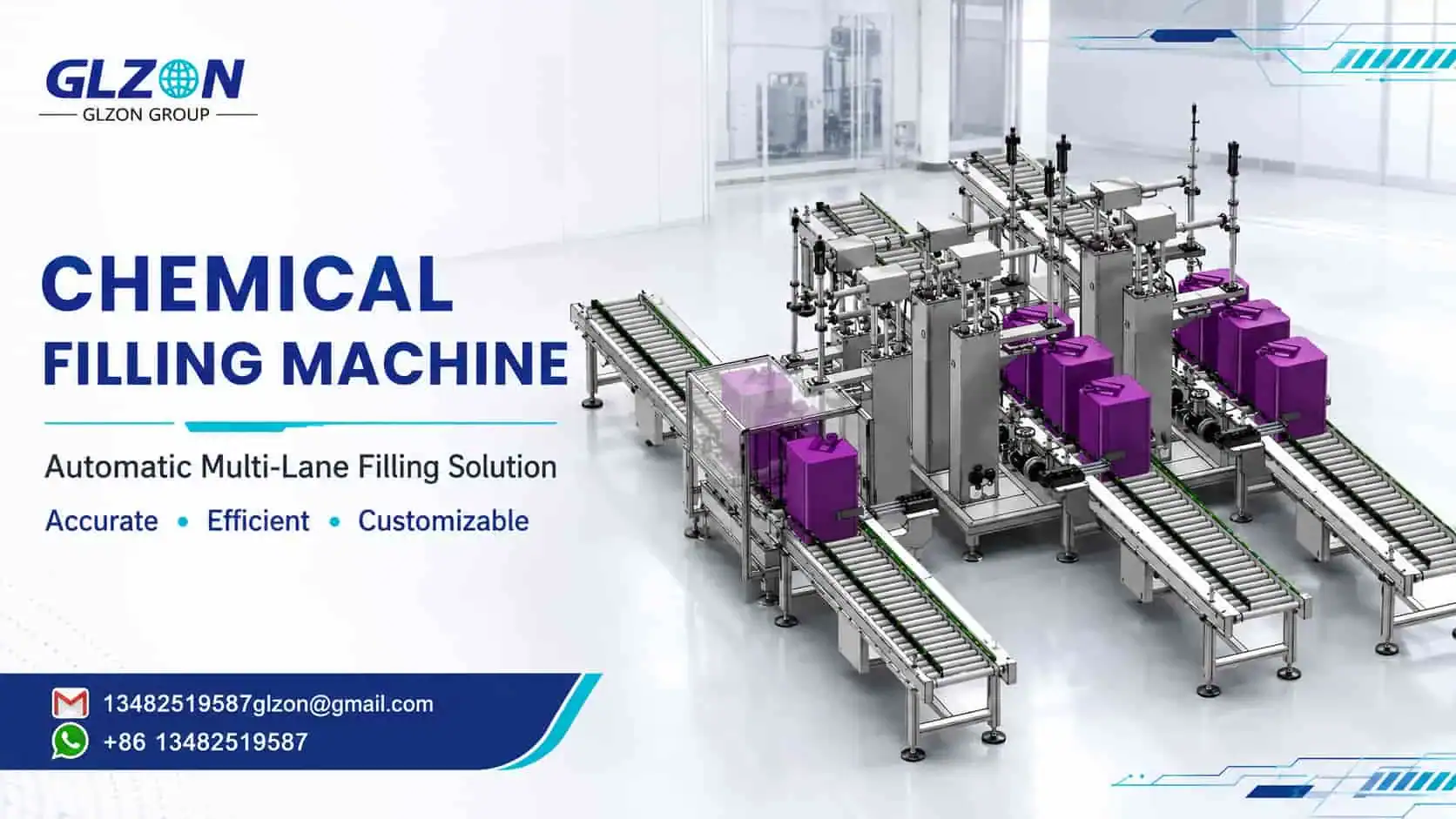
Chemical Filling Machine for Industrial Liquid Packaging
A reliable chemical filling machine helps manufacturers fill industrial liquids accurately, safely and efficiently into bottles, jerry cans, pails, drums and IBC totes.
Chemical products can differ significantly in viscosity, density, corrosiveness, foaming tendency and flammability. Therefore, the filling system must be designed according to the actual material, container and factory environment.
GLZON provides customized chemical filling equipment for industrial chemical manufacturers. Available solutions include standalone filling stations and complete filling, capping, sealing, labeling and conveying lines.
What Is a Chemical Filling Machine?
A chemical filling machine measures and dispenses a specified quantity of liquid chemical into a container.
Depending on the application, the equipment can use:
- Net-weight filling
- Gravity filling
- Pump-assisted filling
- Piston filling
- Volumetric filling
- Flow-meter filling
The correct technology depends on the chemical’s properties, container size, required output and filling-accuracy target.
Small bottles may require a multi-nozzle volumetric system, while pails, drums and IBC totes are commonly handled using industrial weight-filling equipment.
Chemical Products That Can Be Filled
A properly configured chemical liquid filling machine can be used for different industrial and household products, including:
- Liquid detergent
- Laundry detergent
- Disinfectant
- Bleach
- Cleaning chemicals
- Liquid fertilizer
- Pesticide
- Agrochemical products
- Water-treatment chemicals
- Lubricants
- Engine oil
- Coating materials
- Resin
- Adhesive
- Solvent-based products
- Other industrial liquids
The product’s safety data sheet should be reviewed before the machine configuration is confirmed. This helps determine suitable pumps, seals, hoses, valves, nozzles and product-contact materials.
Why Chemical Filling Requires Specialized Equipment
Chemical liquids cannot all be handled by the same standard filling machine. Important material characteristics must be evaluated first.
Corrosiveness
Acids, bleach and other corrosive products may damage unsuitable metal components, seals or pipes.
All parts that contact the liquid should be selected according to chemical compatibility. The correct solution may require stainless steel, engineering plastic, special seals or corrosion-resistant components.
Viscosity
Water-like chemicals flow easily, while detergents, resins and adhesives can be considerably thicker.
Viscosity affects:
- Filling speed
- Pump selection
- Pipe diameter
- Nozzle diameter
- Valve design
- Cleaning procedure
A viscous product may require pump-assisted feeding, while a low-viscosity product may be suitable for gravity or pressure filling.
Foaming
Detergents, cleaning liquids and some water-based chemicals can generate foam during filling.
A diving nozzle or controlled filling-speed program can help reduce turbulence. The machine can fill quickly during the first stage and reduce the speed as the liquid approaches the container opening.
Flammability
Some solvents and chemical formulations can produce flammable vapours.
The manufacturer must review the product’s flash point, safety data sheet and factory hazardous-area classification. Explosion-protected electrical and pneumatic components may be required.
Any required certification should be confirmed in the technical proposal instead of being assumed.
Filling Accuracy
Incorrect filling creates product loss, underfilled packages and quality-control problems.
A well-designed chemical packing machine can use weighing, flow measurement or volumetric control to provide repeatable filling. The appropriate method depends on the container and product.
Available Chemical Filling Machine Configurations
Semi-Automatic Chemical Filling Machine
A semi-automatic system is suitable for smaller production volumes, frequent container changes and factories that require flexible operation.
The operator normally places the container below the nozzle and starts the filling cycle. The machine automatically measures the product and stops when the target quantity is reached.
Advantages include:
- Lower investment
- Compact footprint
- Flexible container handling
- Simple operation
- Convenient product changeover
- Suitable for small production batches
Automatic Chemical Filling Machine
An automatic chemical filling machine can automatically transport, detect, position, fill and discharge containers.
It can be connected to additional equipment to create a complete production line.
Available functions may include:
- Automatic container feeding
- Container detection
- No-container-no-fill control
- Automatic filling
- Two-stage filling control
- Automatic cap feeding
- Capping or lid pressing
- Induction sealing
- Label application
- Batch-date coding
- Finished-container collection
The required automation level should be selected according to the production target, available labour and factory layout.
Containers Supported
GLZON chemical filling systems can be configured for:
- Small bottles
- Plastic bottles
- Metal cans
- Plastic pails
- Open-top buckets
- 5-litre jerry cans
- 10-litre jerry cans
- 20-litre jerry cans
- 25-litre jerry cans
- Steel drums
- Plastic drums
- IBC totes
Container photographs, dimensions, opening diameter and target filling quantity should be provided before the equipment is designed.
Chemical Bottle Filling Machine
A chemical bottle filling machine is suitable for smaller retail or industrial packages.
Automatic bottle-filling lines can incorporate multiple filling nozzles to increase production capacity. They can also be connected to bottle-feeding, capping, sealing, labeling and coding equipment.
Important factors include:
- Bottle dimensions
- Bottle-neck diameter
- Required fill volume
- Cap type
- Product viscosity
- Foaming tendency
- Required production speed
The nozzle arrangement should match the container opening to prevent splashing, contact and product waste.
Jerry-Can and Pail Filling Equipment
Jerry cans and pails are widely used for detergents, lubricants, cleaning products, agrochemicals and other industrial liquids.
These containers can be filled using a semi-automatic station or an automatic conveyor line.
A complete jerry-can system may include:
- Empty-container loading
- Automatic positioning
- Net-weight or volumetric filling
- Cap placement
- Cap tightening
- Label application
- Batch coding
- Filled-container collection
Different machine models can be configured for 5L, 10L, 20L and 25L containers.
Drum and IBC Chemical Filling Equipment
Large industrial containers are frequently filled by weight.
The empty drum or IBC tote is placed on a weighing platform. Load cells measure the amount of material entering the container and send the information to the filling controller.
A two-stage filling cycle can improve control:
- Fast filling delivers most of the target quantity.
- Slow filling completes the final quantity.
- The valve closes when the target weight is reached.
- The nozzle retracts or moves away from the container.
Drum and IBC systems can be designed as standalone stations or integrated with conveyors, pallet handling and capping equipment.
Key Features of GLZON Chemical Filling Equipment
Depending on the selected model, the system can be configured with:
- High-accuracy weighing control
- PLC and touchscreen operation
- Fast and slow filling stages
- Anti-drip filling nozzle
- Diving filling nozzle
- Recipe storage
- Adjustable filling quantity
- Container detection sensors
- No-container-no-fill protection
- Emergency stop controls
- Suitable chemical-contact materials
- Automatic fault alarms
- Conveyor integration
- Capping and labeling connections
- Customized safety configuration
Final features depend on the application and approved technical design.
Typical Chemical Filling Process
A standard filling process can include the following steps:
- The empty container enters the filling position.
- A sensor confirms that the container is correctly positioned.
- The filling nozzle aligns with the opening.
- The machine begins fast filling.
- Filling speed decreases near the target quantity.
- The controller stops the filling process.
- The anti-drip valve closes.
- The filled container moves to the capping station.
- The cap is installed and tightened.
- The container proceeds to labeling and coding.
The exact process depends on whether the machine is semi-automatic or fully automatic.
How to Choose the Correct Chemical Filling Machine
Before requesting a quotation, prepare the following information.
Product information
- Chemical name
- Safety data sheet
- Viscosity
- Density
- Working temperature
- Corrosiveness
- Foaming tendency
- Flash point
- Cleaning requirements
Container information
- Container type
- Container dimensions
- Opening diameter
- Required filling volume or weight
- Container photographs
- Cap or lid type
Production information
- Required containers per hour
- Number of daily working hours
- Filling-accuracy requirement
- Desired automation level
- Available factory space
- Power supply
- Compressed-air supply
- Destination country
Providing complete information allows GLZON to recommend suitable chemical filling equipment and prepare an accurate technical proposal.
Why Choose GLZON?
GLZON designs filling and packaging machines for chemical, oil, coating, detergent and industrial-liquid applications.
Our services include:
- Customized machine design
- Automatic and semi-automatic solutions
- Bottle, jerry-can, pail, drum and IBC applications
- Filling, capping and labeling integration
- Material and container evaluation
- Factory-layout support
- Machine testing before delivery
- Technical documentation
- Installation and operating guidance
- International shipping support
Our goal is to provide a chemical filling machine that matches the customer’s actual product and production process.
Frequently Asked Questions
Which filling method is best for chemical products?
The correct method depends on viscosity, density, container size and required accuracy. Net-weight filling is commonly considered for pails, drums and IBC totes, while volumetric, piston or flow-meter filling may be suitable for smaller bottles.
Can one machine fill different chemicals?
It may be possible if the products are compatible with the same pump, seals, pipes and contact materials. A suitable cleaning process is necessary to prevent cross-contamination.
Can one machine fill different container sizes?
Yes. Many systems can store different filling recipes and use adjustable guides. However, the complete container-size range must be provided before the machine is designed.
Can the machine handle corrosive chemicals?
A corrosion-resistant configuration can be designed after reviewing the product and safety data sheet. Product-contact materials must be selected according to chemical compatibility.
Is an explosion-protected machine available?
An appropriate safety configuration can be considered for flammable materials. The flash point, hazardous-area classification and applicable certification requirements must be confirmed before manufacturing.
Can you provide a complete production line?
Yes. The chemical filling machine can be integrated with conveyors, capping machines, sealing equipment, labeling machines, coding systems and finished-product handling equipment.
Request a Chemical Filling Machine Quotation
Are you planning a new chemical packaging line or upgrading existing filling equipment?
Send us:
- Product name and safety data sheet
- Viscosity and density
- Container size and photographs
- Filling quantity
- Required production capacity
- Automation requirements
- Destination country
GLZON will prepare a customized machine recommendation and technical quotation.